

A B2B case study establishes trust and credibility near the beginning of the sales funnel, a feat that’s typically difficult to do, especially with the choices available to consumers today. Before you can begin to earn their business, it is imperative that you demonstrate credibility and an ability to deliver on what you promise.
Furthermore, content marketing is more important now than ever in B2B marketing. People are not only interested in your product; they want to know who you and your company are.

Writing a B2B case study is a great way to reach a wider customer base and show them your brand story. But why aren’t more brands rushing out to complete them? Because companies face many hurdles when deciding whether or not to implement case studies into their content marketing strategy.
This article will act as a guide on how to write a B2B case study. It will discuss some of the major hurdles you’ll face when developing one, and what you as a leader can do to eliminate them.

Problem 1: B2B customers are hesitant to sign on for a case study or be mentioned by name
Companies are averse to sharing trade secrets, process improvements, etc. in fear of losing their competitive advantage.

Solution: Create a clear outline of goals, objectives, expectations, and a timeline of the process from the start, while clearly highlighting all the potential benefits a B2B case study provides them.
Be sure to provide your clients with a clear B2B case study format and objective. The clearer your objective and plans are, the more likely your client is to accept your offer.
Ensure your objectives are S.M.A.R.T – Specific, Measurable, Attainable, Relevant, Time-Bound. When your objectives are S.M.A.R.T, you increase your chances for success by identifying the metrics that define success and creating a road map to achieve your goals.
 |
Interested in learning more about S.M.A.R.T goals and how to implement them? Click here to get more insights and resources from HubSpot.
|
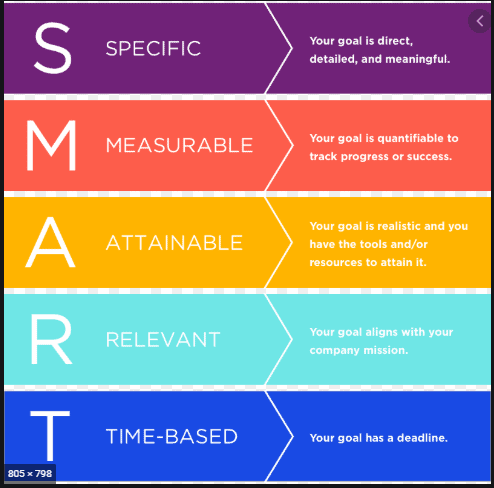
Source: Smart goals chart
Involve the client in every step of the process. They will feel more confident if they know what is going on when it comes to their company information.
Also emphasize what the client is getting out of this. Most businesses, no matter how altruistic, will be reluctant to spend any of their resources on your behalf if they don’t see value in it for them. Retain the client’s confidence by explaining the benefits of a case study, including:
- Brand Exposure
- Employee Exposure
- Company Recognition
According to a Hawkeye study, 71% of B2B buyers in the awareness stage and 77% in the evaluation stage cited testimonials and case studies as the most influential types of content.
(Source: Featured Customers)
Problem 2: The company creating the B2B case study is ill-prepared and does not have sufficient resources to create it properly.
Some companies may not have the time to create a B2B case study. There may be more important projects at hand, like potential sales leads being the main focus at that time. In some cases, companies may have simply never created a B2B case study before. Or they lack the skill set necessary to create an effective one.
Effective B2B case studies also require a variety of analytical tools to determine any positive or negative outcome result from recent changes. If those tools aren’t on hand, the end result will be an unimpressive B2B case study that’s easy to poke holes in, or simply untrustworthy.
Issues like these prevent companies from creating a B2B case study that can ultimately improve their business prospects.
Solution: Simplify the process by doing as much in-depth research as possible, utilizing available resources and aligning your assignments through the proper channels.
Timeline
Life can get in the way sometimes and if you have multiple projects that need your attention, things can get lost down the rabbit hole. It is best practice to be organized and devote designated time to researching and planning your case study.
By creating an internal timeline, you will be able to accelerate the completion of your case study, so that you can refocus efforts back into lead generation. If you have used this practice before, showing your current client your past timelines may help them feel more confident in your ability to create the case study for them.

Action plan for your case study
Assign a Lead Writer
Due to the amount of information being used and the complexity of it all, assign the best person to write the B2B case study: Your best writer.
Have your copywriter lead the project. They will be the best option when it comes to structuring and writing out all the information your team has found during your research process. Your lead writer should interview your primary support personnel and gather all the necessary information concerning the problem and the solution your team was able to create. Working closely together diminishes the chances of information becoming skewed and prevents important factors from being missed.

Outsource…if Needed
If you still lack the human capital and resources to develop a B2B case study, outsource its development to a vendor who is experienced in B2B case studies and ask to see work samples. In some cases, it may be easier to introduce a freelancer to help with this type of task.
If you do choose to involve a freelancer, consider the following:
- Set clear and direct expectations for how you want client interactions to be handled throughout the process.
- Designate a liaison between the freelancer and the client that can facilitate clear communication between the two.
Problem 3: The wrong department is tasked with organizing the case study
Oftentimes, companies assign the wrong department or individual to develop case studies when it is neither their expertise nor their skill set. For example, your sales team should not be organizing or creating a B2B case study. They should be working with customers on closing deals and moving them through the “funnel.” Instead, marketing teams and subject matter experts should work hand-in-hand to develop a B2B case study.
Solution: Make case studies a specific item in your marketing strategy and budget in order to eliminate confusion and diffusion of responsibilities.
While it may be important to incorporate numbers and stats provided by the sales team to track progress, companies may make the mistake of assigning a writing job to a salesperson.
The sales team are not the best choice to conduct the research gathering process. Their specific skill set and focus is not on creating B2B case studies – it is on closing deals. By adding B2B case studies to their list of responsibilities, delays will become inevitable, the result won’t likely be compelling, and sales numbers will be harmed due to their attention being taken away.
By aligning your marketing assignments to the proper channels, your company will be working at its optimal functionality. Read our blog to learn more about the benefits of company alignment and its direct connection to ROI.
Ensure you are communicating with the authorized personnel, like a company representative, to gather information.
Rather than speak with an account representative, a company rep will have more information about the company’s processes and standards. They may be the most knowledgeable about the company facts, important details, and general information you need to create that exemplary B2B case study.
Problem 4: Some B2B companies are just not ready to create a case study.
Some companies may be in the infancy stages of development with little experience to create a well-written and informative B2B case study. They could have been recently acquired and feel as though the previous company information is irrelevant.
They could have a trade show coming up and want to focus their efforts on that, or are managing a few pay-per-clicks campaigns that they believe will do well.
Or they just have excuses to focus on other marketing projects rather than devote the time and energy into a case study.
Solution: Do the case study!
Creating a B2B case study can be intimidating, but as the S.A.S. saying goes, “He who dares, wins.” If you want to truly succeed, you need to push yourself and your team to accomplish tasks they may feel nervous about. Just Keep that B2B case study pitch with you always whenever you feel the company is ready to hear more.
In the long run, a B2B case study may be just what your B2B company needs in order to progress forward.
According to a 2018 study, in the B2B setting, events help generate the most leads, while case studies convert and accelerate most leads. (Source: bluecorona.com)
Share Your Company’s Successes
Creating a B2B case study is a compelling and informative way to not only promote your B2B company, but also to figuratively carve you business’ s successes in stone. It provides that extra layer of proof to your clients (as well as potential clients), of the potency of your services and products. Think of it as a tale of your successes that contributes to your bottom line and ROI in the long run.
In the end, developing a b2b case study is like writing a story. Make it informative, tell the tale your company deserves and watch the leads come pouring in afterwards.
Looking for a way to highlight your company’s achievements and experience with a case study?



![How to Build a B2B Content Marketing Strategy That Actually Drives Sales [2025 Guide]](https://www.dreamfactoryagency.com/wp-content/uploads/2025/04/b2b-content-marketing-strategy-330x242.jpg)