
In 2026, marketing leaders in manufacturing, aerospace, medical, and energy sectors encounter significant opportunities and increased risks. Artificial intelligence can accelerate research, personalize outreach, and convert creative briefs into structured campaign plans in seconds. However, if speed overtakes strategy, the use of vanilla AI utilizations can undermine trust and weaken the authenticity valued by B2B buyers. Successful adoption depends on using AI in its proper role: as an assistant while maintaining the human judgment essential for building relationships.
Why Human Guidance and Oversight Still Matter
B2B buyers invest in the people, institutional knowledege and cultures behind products and services. While automation improves efficiency, it cannot interpret tone, market sentiment, or the nuances that make B2B communication effective. Leading marketing organizations avoid both uncontrolled automation and outright bans. Instead, they implement governance policies, establish human review checkpoints, and train teams on brand voice. This “trust‑but‑verify” approach ensures AI is effective in supporting, rather than replacing, strategic thinking.
Key AI Tools Helping B2B Marketers in 2026
A growing ecosystem of AI platforms can enhance productivity when used within a strategic framework. Below are some of the latest tools that B2B marketing managers, directors, and CMOs should know, organized by primary use case.

Account-Based Marketing
Demandbase’s platform uses AI and data analytics to identify high‑value accounts, rank them by likelihood of conversion and provide detailed insights into account behavior. It unifies sales and marketing on one platform, offering real‑time personalization and comprehensive data integration to support end‑to‑end account‑based marketing.
Search‑Visibility Management
Semrush One monitors a brand’s presence across Google and leading language models, audits AI crawlability and surfaces AI‑powered SEO recommendations. This helps teams capture new traffic sources as generative engines increasingly influence discovery.
B2B AD Generation
Stirling transforms a landing‑page URL into production‑ready LinkedIn creatives and captions, drawing on thousands of successful B2B campaigns. Its “magic editor” lets marketers quickly refine outputs for A/B testing.
Sales‑Call Intelligence
Goran AI transcribes sales calls, scores conversations against frameworks like MEDDIC/BANT and surfaces winning phrases, providing coaching suggestions and objection‑handling examples. The result is a shared playbook that aligns sales messaging with marketing strategy.
Ad Creation & Optimisation
Ad Suite AI uses a guided AI interview to generate briefs, copy and creative for Google and Meta campaigns and automates optimization. BidHelm continuously monitors campaigns, adjusts bids and budgets and adds negative keywords to reduce wasted spend.
Personalized Content Production
Tented.ai ingests brand assets to create on‑brand web pages, microsites, landing pages and even AI‑avatar videos, while niti.ai predicts churn and personalizes campaigns via email, WhatsApp and SMS to stop over‑discounting.
Sales & CRM Automation
ASPR AI deploys specialized agents that capture expertise, generate deal intelligence and update CRM records automatically. GAfix.ai audits Google Analytics 4 and Tag Manager setups to highlight tracking gaps and misconfigured conversions, ensuring data quality before automation.
Creative Design & Asset Generation
Tools like Canvora AI produce presentations and social posts on demand, while Tented.ai extracts brand elements from existing websites to ensure consistency. Jasper and ChatGPT remain versatile writing assistants; Jasper specialises in scalable, high‑quality content creation, while ChatGPT offers multilingual conversational AI and code generation.
These tools demonstrate the wide range of AI applications available to B2B marketers, from ad creation and sales intelligence to analytics and creative design. Each tool delivers value when supported by a clear strategy, quality data, and human oversight.
Integrating AI Into a Market‑Penetration Framework
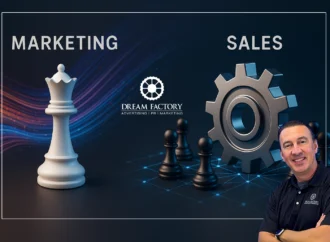
AI adoption should not be an afterthought. The most effective B2B marketing programs integrate automation within a proven market-penetration framework: identify high-value segments, map decision-makers, design multi-channel campaigns, and refine tactics based on real-world results. AI can assist at each stage by predicting likely conversions, drafting personalized messages, optimizing creative variations, or auditing data quality. However, experts who understand industry nuances must develop the underlying plan. Governance policies and human review checkpoints ensure AI output remains on-brand and accurate.
Why Strategic Partners Matter
Dream Factory Agency has developed proprietary market-penetration playbooks for complex industrial and technical sectors over several decades. Unlike technology vendors that present AI as a standalone solution, Dream Factory utilizes AI as a force multiplier for proven, human-led strategies. Our experts assist C-level executives in evaluating new tools within the framework of proven strategies. We integrate them into workflows, and measure outcomes against historical benchmarks. By emphasizing relationship-driven consulting and outcome-focused planning, Dream Factory enables clients to leverage AI without compromising the trust and authenticity valued by B2B buyers.
For marketing managers, directors, and CMOs navigating the crowded AI landscape, the message is clear: use AI as your assistant with appropriate guardrails, not as a do everything strategist. Evaluate tools based on your business objectives, invest in governance and human oversight, and partner with experts who combine market experience with AI expertise. When these elements align, automation becomes a competitive advantage instead of a credibility risk.
Interested in accelerating growth with Dream Factory’s market-penetration playbooks and AI-enhanced strategies? Click here or contact the team at +1 (407) 745-4045 to schedule a 30-minute discovery session.